World Autism Awareness Day 2026: What the Science Actually Says
The theme of World Autism Awareness Day 2026 is “Autism and Humanity — Every Life Has Value.”
Here is the science behind that statement — and why it matters more than ever.
Autism is not one condition
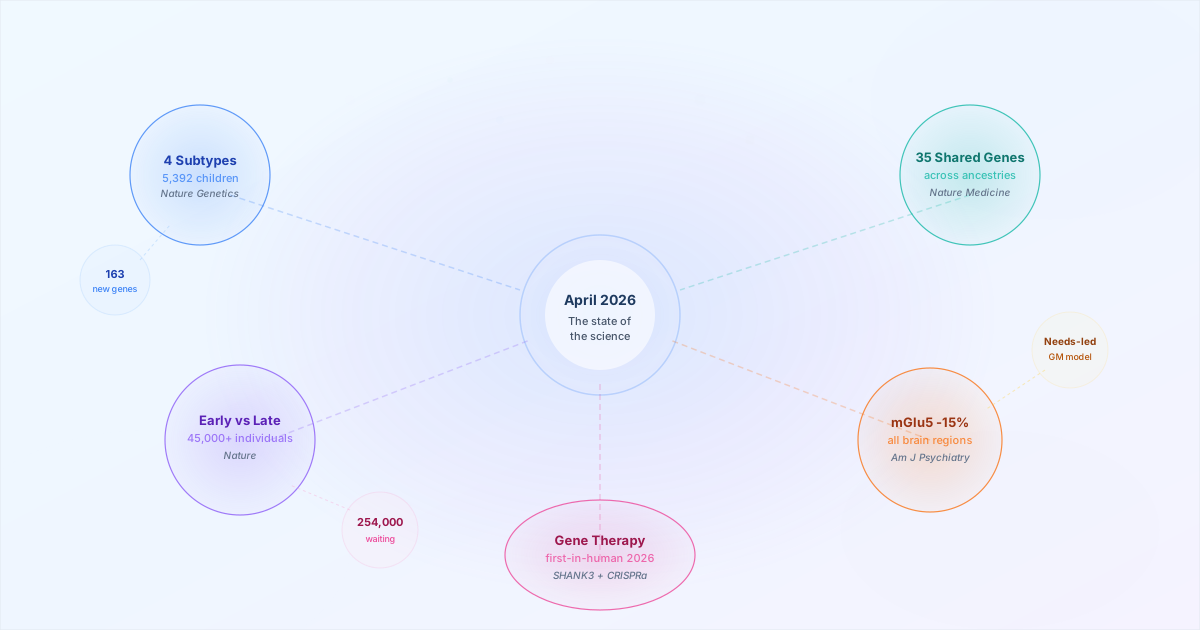
At least four biologically distinct autism subtypes have now been identified. A Princeton-led team analysed 5,392 autistic children and found subtypes with different genetic backgrounds, different co-occurring conditions, and different developmental trajectories. This is the strongest evidence yet that what we call “the autism spectrum” is actually several genetically different conditions sharing a single diagnostic label [1].
Separately, a Cambridge-led study of over 45,000 individuals found that early-diagnosed and late-diagnosed autism have different genetic architectures. Early-diagnosed children carry more rare variants and de novo mutations. Late-diagnosed individuals have higher polygenic scores — and their genetic profile is closer to ADHD and depression than to early-diagnosed autism [2].
This matters for a very practical reason. The rising number of referrals and diagnoses seen internationally is not overdiagnosis. It is the recognition of a genetically distinct subgroup that was always there but never identified.
New genes, shared across ancestries
A University of Washington study has identified 163 new inherited risk genes for autism. These are rare mutations passed from parent to child. Importantly, none of the carrier parents had autism themselves — supporting a multi-hit model where multiple genetic factors must combine before the clinical threshold is crossed. These inherited variants may account for approximately 4.5% of autism cases [3].
And these findings are not limited to European populations. The GALA Consortium, published in Nature Medicine on 30 March 2026, analysed over 15,000 Latin American individuals and found 35 autism-associated genes with extensive overlap with European-ancestry findings. The core genetic architecture appears to be universal — but some signals are only visible when you study diverse populations [4].
If we are serious about “every life has value,” that must include every ancestry. Genetic research that only includes one population is incomplete by design.
A molecular mechanism you can measure
Yale researchers have used PET imaging to show that a glutamate receptor called mGlu5 is approximately 15% lower across all brain regions in autistic adults. This is the first direct molecular evidence, measured in living human brains, supporting the excitatory/inhibitory imbalance theory that has been proposed for over a decade [5].
mGlu5 is a druggable target. This finding does not mean a treatment is imminent, but it means the field now has a measurable biological signal to test treatments against — something that has been missing.
Gene therapy has reached humans
In February 2026, Jaguar Gene Therapy dosed the first cohort of children with Phelan-McDermid Syndrome — a form of autism caused by deletions or mutations in the SHANK3 gene. No treatment-related serious adverse events were reported. There are early signals of benefit across communication, motor function, cognitive domains, and social behaviour [6].
Separately, CRISPR activation — a technique that turns up the working copy of a gene without cutting DNA — has rescued function in neurons and brain organoids for two of the most frequently mutated genes in autism: SCN2A and CHD8 [7]. This is a potentially generalisable approach for the many autism genes that cause problems through haploinsufficiency.
I wrote about what this pipeline means in more depth last week: What the Gene Therapy Pipeline Actually Means for Autism.
The gap between science and services
The science has never been clearer. The services have never been further behind.
In England, 254,000 people are waiting for an autism assessment. Ninety percent have been waiting longer than the NICE-recommended thirteen weeks. That is more than the population of Southampton, and thirteen times the number waiting in April 2019 [8].
But there is a structural change worth noting. Greater Manchester’s needs-led model launched on 31 March 2026. Under this model, support begins at the point of referral — not after diagnosis. Holistic neuro-profiling is now available across all ten localities. If it works, it could serve as a template for other regions [9].
The Fonagy review, commissioned by the UK government, is expected to report this summer. It will examine whether rising demand reflects overdiagnosis or genuine recognition of unmet need. The evidence from the Cambridge genetic architecture study [2] should be central to that conversation: the increase is driven by a genetically distinct late-diagnosed subgroup being identified for the first time, not by diagnostic inflation.
What “every life has value” means in practice
It means genetic subtypes get subtype-specific support — not one-size-fits-all.
It means late-diagnosed adults are not told they are “less autistic” — their genetics may literally be different from those diagnosed in childhood.
It means support starts at need, not at a diagnostic label.
It means research includes all ancestries, not just European.
It means a negative genetic test today does not mean there is nothing to find. Long-read sequencing now detects 33% more structural variants than standard short-read methods, and as sequencing technology improves, more answers will come.
The theme is right. The science supports it. The task now is to make the services match.
References
- Litman T, et al. Identification of autism subtypes based on genetics, co-occurring conditions, and developmental trajectories. Nature Genetics. 2025. Link
- Warrier V, et al. Genetic architecture of early- and late-diagnosed autism. Nature. 2026. Link
- UW Medicine. Study links autism to new set of rare gene variants. 2026. Link
- GALA Consortium. Autism-associated genes identified across Latin American and European ancestries. Nature Medicine. 2026. Link
- Naples AJ, et al. mGlu5 receptor availability in autism spectrum disorder. American Journal of Psychiatry. 2026. Link
- Jaguar Gene Therapy. Successful completion of dosing of first patient cohort in clinical trial evaluating JAG201 for the treatment of Phelan-McDermid Syndrome. BusinessWire, 24 February 2026. Link
- CRISPRa rescues function of haploinsufficient autism genes SCN2A and CHD8. Nature. 2025. Link
- NHS Digital. Autism statistics, April 2024 to March 2025. Link
- Greater Manchester ICB. Greater Manchester autism and ADHD assessment changes 2026. Link
Dr Odet Aszkenasy is a Consultant Community Paediatrician and the author of The Genetics of Autism: A Guide for Parents and Professionals.