What the Gene Therapy Pipeline Actually Means for Autism
Something significant happened in February 2026. A gene therapy for a form of autism was given to a human being for the first time.
That sentence needs some unpacking — because what it means, and what it does not mean, are both important.
The three approaches currently in or near humans
JAG201 — Phelan-McDermid Syndrome
Phelan-McDermid Syndrome is caused by deletions or mutations in the SHANK3 gene on chromosome 22. SHANK3 codes for a protein that is critical for the connections between nerve cells. When one copy is missing or damaged, those connections do not form properly.
JAG201 is a gene therapy that delivers a working copy of SHANK3 directly to the brain. In February 2026, the first patient cohort received it. Early results — still preliminary — show no treatment-related serious adverse events, and there are early signals of benefit across communication, motor function, cognitive domains, and social behaviour. The second cohort is expected to receive the therapy in the second quarter of this year.
This is not a large trial. It is an early-phase study. But the fact that it is happening at all marks a genuine threshold.
CRISPRa — SCN2A and CHD8
This approach is different in a subtle but important way. Standard CRISPR editing cuts DNA. CRISPRa does not cut anything. Instead, it attaches to the promoter region of a gene and turns up its activity — like increasing the volume on the working copy of a gene that is present but underexpressed.
This matters enormously in autism genetics, because many high-confidence autism genes are haploinsufficient. You have two copies. One is faulty. The other is functional but not working hard enough on its own. CRISPRa nudges the healthy copy to compensate.
This approach has now been demonstrated in neurons and in brain organoids — lab-grown tissue that mimics brain development — for two of the most frequently mutated genes in autism: SCN2A and CHD8. The SCN2A approach has been licensed to Regel Therapeutics for clinical development. CHD8 remains the most commonly mutated single gene found in autism, and it is now a target.
Zorevunersen — Dravet Syndrome
Dravet Syndrome is caused by loss-of-function mutations in SCN1A, a gene that codes for a sodium channel critical to inhibitory neurons in the brain. It produces a severe, treatment-resistant epilepsy that begins in infancy, and it carries significant cognitive and developmental consequences.
Zorevunersen is an antisense oligonucleotide — a short piece of synthetic genetic material that modulates how the remaining functional copy of SCN1A is read. In NEJM data, it produced up to 91% reduction in seizure frequency. Phase 3 trials are now enrolling in the UK, the United States, and Japan.
Dravet Syndrome is not an autism diagnosis, but it illustrates the same genetic principle at work across this pipeline: haploinsufficiency correction. Fix the gene dose. Reduce the downstream harm.
What this is not
None of these approaches are about changing autistic people. None of them are about erasing autism. None of them are targeted at the social and communication profile that defines autism as a neurodevelopmental condition.
They are targeted at the medical complications that arise in specific genetic subtypes — severe seizures, profound intellectual disability, loss of spoken language. These are the consequences that cause the greatest suffering and the greatest reduction in quality of life, for the person and for their family.
The distinction matters. Autism is not a disease to be eliminated. But within the autism spectrum there are children whose seizures are catastrophic, whose language never develops, whose cognitive impairment is severe — and for them, a gene-specific intervention that addresses the biological mechanism causing that harm is not a threat to neurodiversity. It is treatment.
A pattern worth understanding
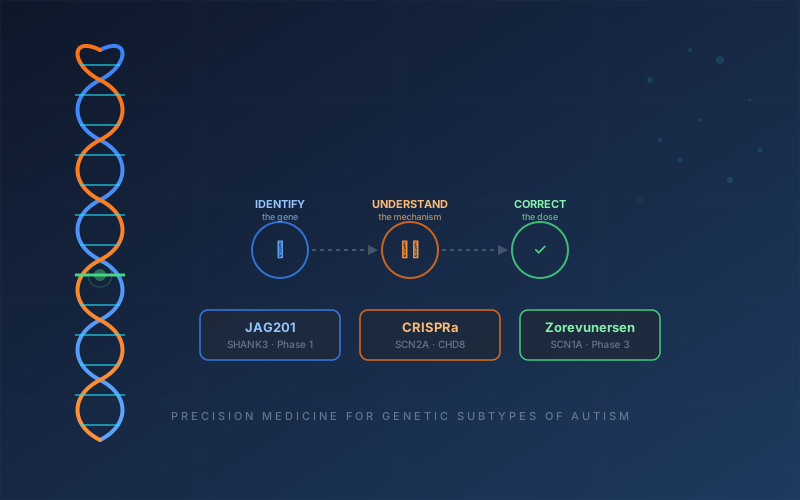
What connects JAG201, CRISPRa, and Zorevunersen is a shared logic: identify the gene, understand the mechanism, correct the dose.
This is precision medicine arriving at autism. Not for all autism — that would be a category error, because autism is not one condition caused by one gene. But for the subset of autism where a single high-confidence gene is the primary driver, the pipeline is real, it is moving, and some of it is already in humans.
For families who have received a genetic diagnosis — SHANK3, SCN2A, CHD8, SCN1A, or any of the growing list of high-confidence autism genes — it is worth staying close to this literature. The landscape is changing quickly.
For everyone else, the most useful thing to understand is the distinction between treating the medical complications of a genetic condition and changing what it means to be autistic. Both conversations need to happen. They should not be confused with each other.
References
- Jaguar Gene Therapy. Successful completion of dosing of first patient cohort in clinical trial evaluating JAG201 for the treatment of Phelan-McDermid Syndrome. BusinessWire, 24 February 2026. ClinicalTrials.gov identifier: NCT06662188. Note: these are company-reported preliminary data; peer-reviewed publication of clinical results is anticipated but has not yet appeared.
- The Transmitter — CRISPRa for SCN2A and CHD8.
- Regnante F, et al. Zorevunersen in children and adolescents with Dravet Syndrome. New England Journal of Medicine. 2026.
Dr Odet Aszkenasy is a Consultant Community Paediatrician and the author of The Genetics of Autism: A Guide for Parents and Professionals.