Why Is My Autistic Child's Head Larger? What Brain Organoids Tell Us About Macrocephaly and Autism
If your autistic child has a larger-than-average head, you are not imagining it. Between 10% and 20% of autistic children have macrocephaly — a head circumference above the 97th percentile (1, 2). It is one of the oldest and most consistently documented physical observations in autism research, measurable at routine health visitor checks long before any behavioural diagnosis is made.
But until recently, we did not know why. What was actually happening in the developing brain to make it grow larger? A 2026 study published in Cell Stem Cell has provided the first cellular-level answer, using patient-derived brain organoids — tiny “mini-brains” grown in the laboratory from the stem cells of autistic individuals (3).
What is macrocephaly?
Macrocephaly simply means a large head. In clinical practice, it is defined as a head circumference above the 97th percentile for age and sex. In the general population, about 3% of children meet this criterion by definition. In autistic children, the proportion is substantially higher — estimates range from 10% to 20%, depending on the study (1, 2).
It is important to be clear about what macrocephaly is and is not:
- It is not a diagnosis. Many children with large heads are entirely neurotypical. Family head size matters — if both parents have large heads, the child probably will too
- It is not specific to autism. Macrocephaly occurs in other neurodevelopmental conditions and in isolation
- Not all autistic children have large heads. The majority do not. Macrocephaly defines a subgroup, not the whole population
- It is measurable early. Head circumference is routinely checked in infancy, which makes it one of the few physical measurements that can be tracked before behavioural signs emerge
The observation that some autistic children have unusually large heads has been in the research literature since the 1990s (4). What was missing was a mechanism — which cells were responsible, and what were they doing differently?
What the organoid study found
Brain organoids are three-dimensional structures grown from human stem cells. They are not brains — they lack blood vessels, immune cells, and the complex architecture of an actual human brain — but they do recapitulate the early stages of cortical development with remarkable fidelity. Researchers can watch cell types emerge, divide, and differentiate in real time.
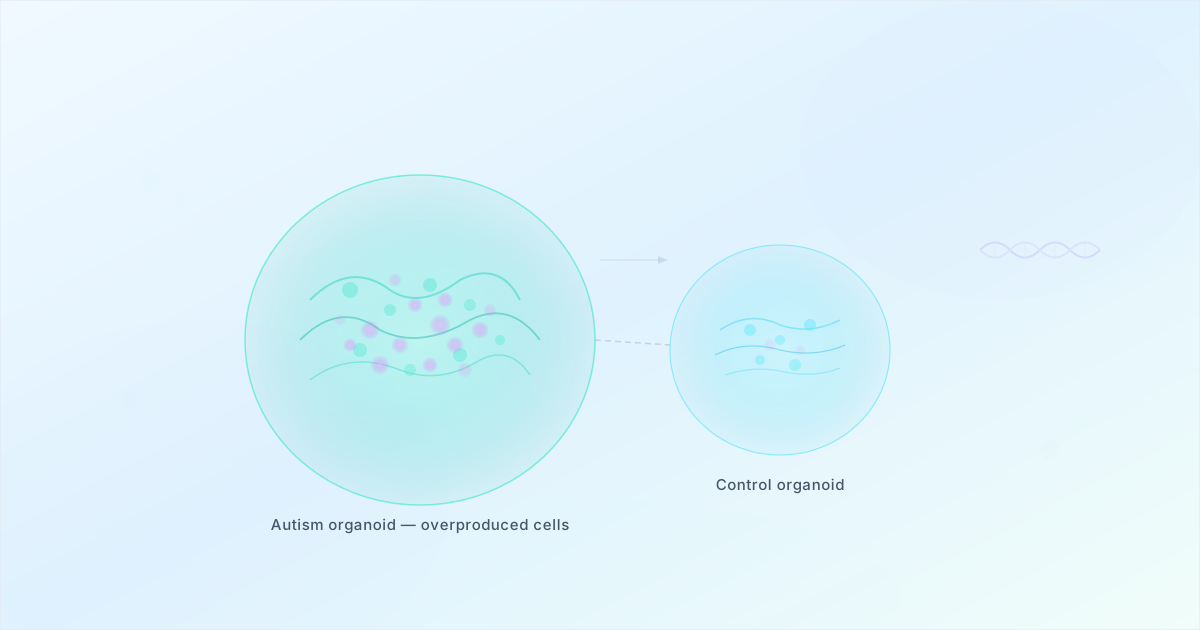
In this study, the researchers grew organoids from the stem cells of autistic individuals with macrocephaly and compared them to organoids from neurotypical controls (3). What they found was striking:
- Two specific cell populations were overproduced in the autism organoids during early cortical development
- These cells are involved in building the cerebral cortex — the outer layer of the brain responsible for higher-order functions
- The overproduction meant the organoids grew larger, mirroring the macrocephaly seen clinically
- Critically, this overgrowth pattern was detectable at a stage of development that corresponds to the prenatal period — before clinical symptoms would ever appear
This is not a subtle statistical trend. The organoids from autistic individuals with macrocephaly were visibly, measurably larger because they were producing more of these specific cell types, faster than they should.
How this connects to the bigger picture
This study does not exist in isolation. It sits alongside a major 2026 convergence study by Geschwind and colleagues, published in Nature, which showed that different autism-linked genetic mutations — many of which affect different genes entirely — converge on shared developmental pathways in the developing brain (5).
Together, these two studies tell a coherent story:
- Different mutations in different autism-associated genes
- Converge on shared pathways during early brain development
- Affect specific cell populations — in the case of macrocephaly, causing overproduction of particular cortical cell types
- Result in measurable brain overgrowth that can be detected clinically as macrocephaly
This is the trajectory of modern autism research: from “which genes?” to “which pathways?” to “which cells?” Each layer of resolution brings us closer to understanding what is actually happening biologically — and, eventually, to being able to do something about it.
What this means for families
If your child has been noted to have a large head, this research gives that observation new potential significance. Here is what it means in practical terms:
- Head circumference is already measured routinely in infancy by midwives, health visitors, and GPs. This research does not require any new test — it gives existing measurements a new biological context
- It does NOT mean large head = autism or small head = not autism. This is a subgroup finding, not a screening tool
- In the future, early brain growth patterns combined with genetic data could improve early identification of children who would benefit from developmental support. That future is not here yet, but this study moves it closer
- The organoid approach means this research can be done without brain biopsies. The “mini-brains” are grown from the child’s own cells (typically derived from a skin or blood sample), which makes this kind of research feasible and ethical in a way that brain tissue studies are not
- If your child has macrocephaly and autism, this research suggests that the brain overgrowth is not random — it has a specific cellular basis. That is a meaningful step from “we don’t know why” to “we are beginning to understand the mechanism”
What it does not mean
- This is laboratory research, not a clinical tool. No one is going to diagnose or screen for autism using brain organoids in a clinic any time soon
- Head circumference alone cannot predict autism. It never could, and this study does not change that
- The two overproduced cell populations have not yet been linked to specific genetic mutations in this particular study. That connection will come from future work
- Replication in larger cohorts is needed. The organoid findings are compelling but based on a relatively small number of individuals
- There is no treatment implication yet. Understanding mechanism is the necessary precursor to intervention, but we are not at the intervention stage for this particular finding
References
- Sacco R, et al. Head circumference and brain size in autism spectrum disorder: a systematic review and meta-analysis. Psychiatry Research: Neuroimaging. 2015;234(2):239-251.
- Courchesne E, et al. Evidence of brain overgrowth in the first year of life in autism. JAMA. 2003;290(3):337-344.
- Glass IA, Matoba N, et al. Human cortical organoids recapitulate inter-individual variability in infant brain-growth trajectories. Cell Stem Cell. 2026;33(1):142-156.e7.
- Lainhart JE, et al. Macrocephaly in children and adults with autism. Journal of the American Academy of Child & Adolescent Psychiatry. 1997;36(2):282-290.
- Gordon A, Yoon S-J, Bicks LK, et al. Developmental convergence and divergence in human stem cell models of autism. Nature. 2026;651:707-719.
Dr Odet Aszkenasy is a Consultant Community Paediatrician and the author of The Genetics of Autism: A Guide for Parents and Professionals.